
7 Tips to Choose the Best Abrasion Resistant Rubber Hose
Choosing the right Abrasion Resistant Rubber Hose is not a simple catalog decision. It affects downtime, worker safety, maintenance costs, and production quality. A hose carrying sharp aggregate, wet sand, cement slurry, or metal particles faces constant mechanical punishment. Its outer cover may look strong, yet the inner tube can wear silently.
Charles Goodyear, whose vulcanization work shaped modern rubber engineering, observed, “The use of rubber is almost unlimited.” His statement still matters, but rubber is not universal. No hose survives every abrasive medium. That is the uncomfortable truth. Selection must match the material, pressure, temperature, flow speed, and installation layout. A hose dragging across concrete needs different protection from one suspended inside a processing line. Small details matter.
This guide presents seven practical tips for choosing an Abrasion Resistant Rubber Hose with greater confidence. It considers rubber compound quality, tube construction, reinforcement, bend radius, pressure ratings, and environmental exposure. It also explains why a higher wear rating may not solve poor routing or excessive pulsation. I have seen specifications look impressive on paper, then fail near a tight flange or sharp support. That possibility deserves attention.
Reliable decisions require more than comparing prices. Check technical datasheets, request test evidence, and discuss the application with a qualified hose engineer. Ask how abrasion was measured. Ask whether the result reflects your actual material. A few minutes of questioning can prevent weeks of replacement work. Even experienced buyers can overlook one factor. That is why careful review remains essential.
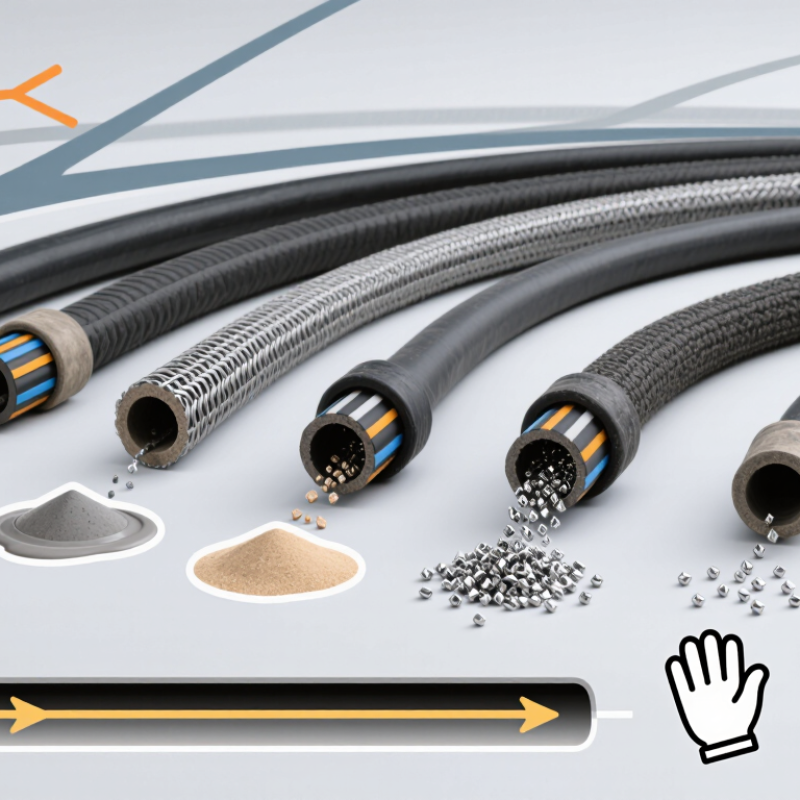
Understand Abrasion Resistance and Identify the Hose Application
Abrasion resistance starts with the application, not the hose catalog. Map the material, pressure, temperature, movement, and contact surface. Sand, cement, gravel, and metal chips wear rubber differently. A hose dragging across a concrete floor needs different protection from one carrying slurry through a tight bend. The wrong choice can fail quietly. That is dangerous.
Check the particle size and velocity. Fine dust may polish the tube, while sharp aggregate can cut it. Ask for test evidence using ISO 4649 or another recognized abrasion method. These tests compare rubber volume loss, but laboratory results cannot copy every job site. Field experience still matters. I have seen a thicker hose perform poorly when its bend radius was ignored. More rubber is not always better.
Review the hose construction, cover, reinforcement, and inner-tube compound together. A strong cover cannot compensate for a weak tube. Confirm working pressure at the actual temperature, because heat can reduce rubber strength. Grand View Research valued the global industrial hose market at about USD 4.4 billion in 2022, reflecting broad demand across construction, mining, and manufacturing. That scale does not make selection easier. It creates more specifications to question. Request service-life records, inspection intervals, and failure photos from comparable applications. Look for measurable evidence, not impressive wording.
Compare Rubber Compounds, Reinforcement, and Construction Quality
7 Tips to Choose the Best Abrasion Resistant Rubber Hose
Abrasion resistance begins with the rubber compound, not wall thickness. Natural rubber often handles impact and sliding aggregate well, while nitrile rubber suits oily materials. EPDM performs better with heat, water, and weathering. Polyurethane may resist cutting strongly, but it is not automatically the best choice for every hose. Compare hardness, tensile strength, elongation, and volume loss. ISO 4649:2017 measures abrasion through volume loss in mm³; lower loss generally indicates better wear resistance. ASTM D5963 also evaluates hose abrasion using a rotating drum method. Ask for test conditions, not only impressive numbers.
Reinforcement controls pressure stability and bending behavior. Textile plies can provide flexibility for short movements. Steel-wire layers support higher pressure and repeated pulses. A separate helix helps prevent collapse during suction. Match reinforcement to working pressure, vacuum, bend radius, and movement frequency. These are practical checks. A hose can survive abrasion and still fail at its coupling. Inspect wire placement, cover thickness, liner bonding, and end finishing. Poor concentricity often leaves thin spots that appear after weeks of dragging.
Construction quality deserves a physical inspection. Cut a sample and check for voids, uneven curing, or trapped fabric. Confirm the stated temperature range with the actual slurry temperature; laboratory data may not mirror a vibrating pump line. Industry testing guidance emphasizes controlled speed, load, and contact surface, yet field conditions remain less tidy. That limitation matters. Choose the compound, reinforcement, and construction together, then request batch-level test records and pressure-cycle results.
7 Tips to Choose the Best Abrasion Resistant Rubber Hose - Compare Rubber Compounds, Reinforcement, and Construction Quality
| Tip | Key Dimension | Options to Compare | Practical Selection Guidance | How to Verify Quality |
|---|---|---|---|---|
| 1 | Rubber compound and abrasion resistance | Natural rubber: excellent abrasion resistance and elasticity. SBR: good abrasion resistance with balanced cost and performance. NBR: selected when oil resistance is also required, with generally moderate abrasion resistance. | For dry bulk solids, mineral slurry, sand, and gravel, prioritize a compound specifically formulated for abrasive service rather than choosing only by hardness. | Request laboratory abrasion results using a recognized method such as ISO 4649 or ASTM D5963. In these tests, lower volume loss generally indicates better abrasion resistance. |
| 2 | Hardness and flexibility balance | Typical abrasion-resistant hose linings commonly fall around 60–75 Shore A, depending on the compound and application. | Choose a harder lining for severe sliding wear, but avoid excessive hardness when the hose must bend frequently or absorb impact from large particles. | Check Shore A hardness, minimum bend radius, and low-temperature flexibility. Confirm that the selected hose remains flexible at the site's lowest operating temperature. |
| 3 | Inner lining thickness | Standard-duty linings may be approximately 3–5 mm, while heavy-duty abrasive-service linings are often about 6–12 mm or more. | Select a thicker lining for high solids concentration, sharp particles, high flow velocity, or continuous service. Do not use lining thickness alone as a substitute for compound quality. | Measure lining thickness at several points and inspect for uniformity, smoothness, pinholes, blisters, and visible separation between layers. |
| 4 | Reinforcement construction | Textile plies: flexible and suitable for many moderate-pressure applications. Steel-wire reinforcement: higher pressure capability and improved resistance to elongation, but typically less flexible. | Match the reinforcement to working pressure, surge pressure, vacuum conditions, hose length, and movement. Use a hose designed for suction service when vacuum resistance is required. | Review the rated working pressure, pressure-test requirement, vacuum rating, reinforcement type, and applicable hose standard. Never size the hose from burst pressure alone. |
| 5 | Cover and environmental resistance | Cover compounds may be optimized for abrasion, ozone, weather, oil, chemicals, heat, or flame. No single rubber compound provides maximum resistance to every condition. | Choose an abrasion-resistant cover that also matches exposure to sunlight, moisture, oils, chemicals, temperature, and outdoor storage conditions. | Confirm the stated operating-temperature range and chemical compatibility. Inspect the cover for cracking, hardening, swelling, cuts, and ozone checking after testing. |
| 6 | Construction quality and bonding | Compare mandrel-built, smooth-bore, corrugated, and multi-layer constructions. Consistent layer bonding and accurate dimensions are essential for service life. | Prefer a smooth, uniform bore for abrasive flow and a construction that prevents liner movement, ply separation, and localized kinking. | Check bore diameter, wall thickness, concentricity, appearance, adhesion between layers, end-finish quality, and evidence of hydrostatic pressure testing. |
| 7 | Application conditions and total service life | Service life depends on particle size and shape, solids concentration, flow velocity, pressure, temperature, bend radius, installation, and maintenance. | Select by the complete duty profile. A slightly higher initial cost can be justified when the hose reduces shutdowns, replacement labor, leakage, and disposal costs. | Record operating data, rotate or reposition compatible hoses when permitted, inspect high-wear zones regularly, and replace the hose before the lining reaches its minimum safe thickness. |
Match Hose Size, Pressure Rating, and Operating Temperature
7 Tips to Choose the Best Abrasion Resistant Rubber Hose
Match Hose Size, Pressure Rating, and Operating Temperature
Choosing an abrasion-resistant rubber hose starts with the material path, not the catalog label. Measure the required inside diameter carefully. A narrow hose can increase friction, heat, and pump load. An oversized hose may reduce flow speed and create handling problems. Check the bend radius near elbows, clamps, and machine connections. Do not guess.
Pressure selection requires more than comparing one number. Confirm the hose’s continuous working pressure, not only its burst pressure. Include pump surges, water hammer, and pressure changes during startup. Couplings and clamps must support the same rating. In field inspections, damaged covers often appear near poorly supported joints. That detail is easy to miss. A pressure rating can also change when the hose operates above its reference temperature.
Operating temperature includes the conveyed material, surrounding air, sunlight, and nearby equipment. Heat changes everything. Review the rubber compound’s temperature range and any required derating. Hot slurry may soften the tube, while cold conditions can reduce flexibility and increase cracking. Record the actual temperature at the hose, rather than relying on the process setting. This step is sometimes skipped, and it can lead to an avoidable selection error. Inspect the hose after installation, because vibration and abrasion may reveal problems before a scheduled replacement.
Evaluate Flexibility, Wear Life, and Compatibility with Materials
When selecting an abrasion resistant rubber hose, flexibility deserves as much attention as wall thickness. A stiff hose may survive sliding contact but resist movement around pumps or loading arms. Measure the minimum bend radius during real installation, not on a clean workshop floor. Watch for sharp folds, twisting, and flattened sections. Small installation errors can shorten service life quickly.
Wear life depends on more than rubber hardness. Check the abrasive material’s size, shape, moisture, and flow speed. Coarse sand may cut differently from wet mineral slurry. Ask for test data under conditions close to your process. Then inspect hose surfaces during scheduled maintenance. A thin spot, exposed reinforcement, or bulge needs immediate attention. I once trusted a general wear rating and overlooked repeated impact at one transfer point. That assumption was costly.
Compatibility with materials is equally practical. Confirm resistance to the conveyed product, cleaning chemicals, oils, and operating temperature. A hose may handle dry powder well but soften after contact with an aggressive cleaner. Check both inner tube and cover compounds. Also consider static control, pressure surges, and outdoor exposure. Laboratory charts help, but field conditions can disagree. Leave room for uncertainty, and record inspection findings after the first weeks of operation. That record often reveals whether flexibility, wear life, or chemical compatibility is the actual limitation.
Check Safety Standards, Maintenance Needs, and Total Cost
Choosing the best abrasion-resistant rubber hose starts with safety, not price.
Confirm the hose matches pressure, temperature, fluid, and material type. For sand or grit blasting, check ISO 3861 requirements. ISO 4649 provides a recognized method for comparing rubber abrasion resistance. These tests help, but they do not reproduce every site condition.
Inspect the hose before installation. Look for exposed reinforcement, deep cuts, bulges, flattened sections, and cracked couplings. Keep the bend radius above the manufacturer’s limit. Support heavy hoses near connections. Rotate hose positions when practical, because one-sided wear can remain hidden.
The U.S. Bureau of Labor Statistics recorded about 2.6 million nonfatal private-industry injuries and illnesses in 2023. Poor hose control can add avoidable exposure to that risk.
Maintenance cost deserves equal attention. The U.S. Department of Energy’s Operations and Maintenance Best Practices Guide reports that preventive maintenance can reduce costs by roughly 12–18% compared with reactive work.
Track inspection hours, replacement frequency, downtime, and disposal costs. A cheaper hose may fail earlier under sharp aggregate or constant flexing. That calculation is often incomplete. I would compare total cost over the expected service life, including clamps, labor, cleanup, and lost production. Keep inspection records with dates and photos. Small details matter.