How to Choose the Right Fountain Water Pump
Choosing the right fountain water pump starts with the fountain itself, not the biggest number on a product label. A small basin with a narrow nozzle needs less flow than a tall centerpiece that sends water several feet into the air. Measure the lift from the pump to the outlet, then check the manufacturer’s flow chart at that height. Maximum flow is usually measured with little or no lift, so it can be misleading. Details matter.
Consider the fountain’s shape, tubing diameter, and desired water pattern. A pump that pushes too much water may splash the surrounding patio and empty a shallow basin quickly. Too little flow can leave the feature looking weak. Check whether the model is rated for continuous use and whether its intake screen can handle leaves or grit. For outdoor installations, confirm that the pump and electrical setup are suitable for the location, and follow the manufacturer’s instructions. Keep access for cleaning in mind; a pump hidden beneath heavy stones may become a chore to reach. Energy use also adds up when the pump runs all day, so compare wattage alongside performance. A simple test can help: fill the fountain, run the pump, and watch the stream and water level. Still, one test may not show how evaporation or wind will affect it later. Choosing well means balancing reliable circulation, practical maintenance, and the sound and splash you actually want.
Set the Flow Target: A Common Rule Is About 100 GPH per Inch of Spillway Width
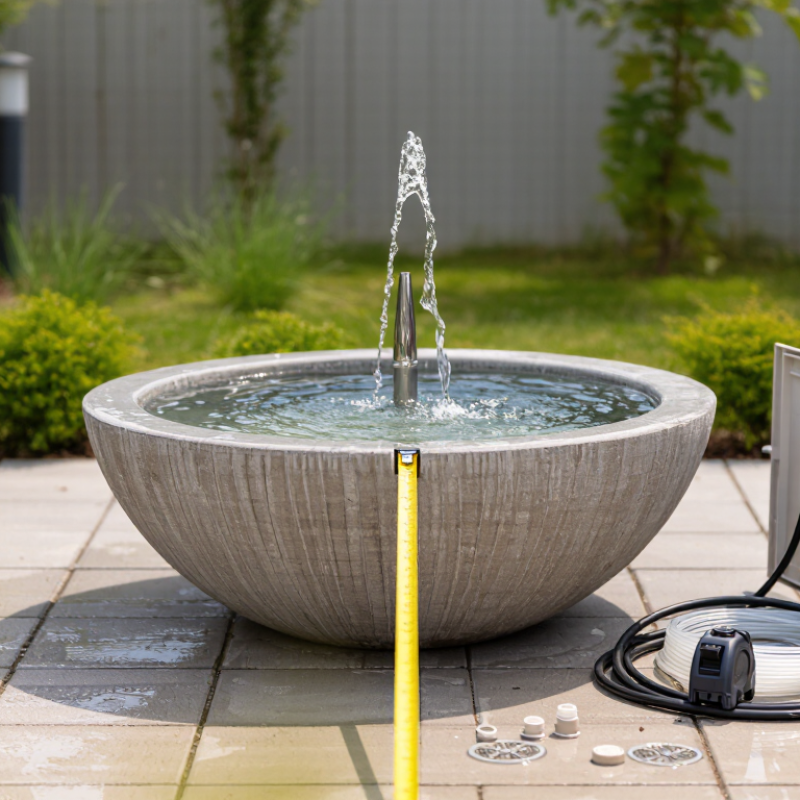
Set the flow target from the spillway’s usable width. A common pond-industry rule is about 100 gallons per hour (GPH) per inch. A 12-inch spillway therefore starts near 1,200 GPH. Treat this as a starting point, not a guarantee. The target should be available at the pump’s installed operating head, not merely listed as its maximum flow at zero head.
Head includes the vertical lift from the water source to the spillway, plus resistance from pipe length, bends, valves, and filters. The U.S. Department of Energy’s Improving Pumping System Performance: A Sourcebook for Industry explains that actual flow depends on the interaction between a pump’s performance curve and the system curve. In practice, a narrow pipe or several sharp turns can weaken the sheet of water. The common rule can miss that. Check the pump curve at your measured head, then allow room to adjust the flow.
Tips: Measure the spillway’s clear width in inches. Compare the pump curve with your estimated head, and use a flow-control valve to fine-tune the curtain. Watch the edge: uneven flow may signal poor leveling, not just low GPH. Recheck after adding filters or changing pipework.
How to Choose the Right Fountain Water Pump
Set a flow target using a common rule of thumb: about 100 gallons per hour (GPH) for each inch of spillway width.
These figures are starting-point estimates. Choose a pump that can deliver the target flow at your installation’s total lift height, and allow for flow losses from tubing, fittings, and other restrictions.
Measure Total Head: Add Vertical Lift and Pipe-Friction Losses
Before choosing a fountain pump, measure the total head it must overcome. This is more than the height of the fountain. Measure vertically from the pond’s normal water surface to the highest point where water exits. If the water level changes, use the lowest level the pump will encounter. A tape measure and a steady reference point help.
Then estimate pipe-friction loss. Water loses pressure as it travels through tubing, especially through narrow pipes, long runs, elbows, and valves. Check a flow-and-friction chart for the pipe size and intended flow rate; fittings may add meaningful resistance. Small details matter. A 1.2-meter vertical lift plus an estimated 0.5-meter friction loss gives about 1.7 meters of total head. Treat that number as an estimate, not a guarantee.
Compare the required flow rate at that total head with the pump’s performance curve. A pump rated for a certain flow at zero head may deliver much less once connected to your fountain. I would recheck pipe length and fitting counts before buying; those are easy to underestimate. If the curve is unclear, measure the actual discharge after installation and adjust the layout or flow control as needed.
Read the Pump Curve at Your Operating Head, Not at Zero Head
A fountain pump’s maximum flow is usually measured at zero head, with no meaningful lift or plumbing resistance. That figure can look impressive. It does not describe the flow at your fountain. Read the pump curve at the head your installation will actually create. For an open fountain, estimate the vertical rise from the water surface to the nozzle, then account for losses through tubing, bends, and fittings. A narrow hose can add more resistance than expected.
Find that operating head on the curve and check the flow shown there. If the nozzle needs a steady, tall plume, compare its flow requirement with this point—not the pump’s zero-head rating. I have seen a pump move plenty of water into a bucket yet produce a weak fountain through long, narrow tubing. Small details matter. Measure the hose’s inside diameter, not just its outside width, and include every tight bend. If your estimate falls between curve markings, treat the result as approximate; real fittings and water levels are rarely perfect. Leave some capacity for changing conditions, but avoid choosing a pump by maximum flow alone. A quick test with the installed nozzle can reveal what the chart cannot. I still find this step easy to rush. Don’t.
Match Tubing Diameter to the Pump’s Rated Flow and Outlet Size
Choose tubing by its inside diameter, not its outer appearance. A hose that looks close may still restrict water if its opening is too narrow. Check the pump outlet size and the tubing dimensions before buying. The connection should fit securely without stretching the hose or forcing it over the outlet.
Then compare the tubing with the pump’s rated flow. Narrow tubing increases resistance, so less water may reach the fountain than the rating suggests. Long runs and bends add more resistance. For a small tabletop fountain, a short, appropriately sized tube usually makes flow easier to control. Keep it simple.
The pump’s rating is not a promise of the flow you will see at the fountain. Lift height matters: water pushed higher generally flows more slowly. If the stream looks weak, check for kinks, a clogged intake, or a tube that is too narrow before replacing the pump. A flow-control valve can help, but turning it down too far may strain some setups. Measure, test, and adjust; one detail is easy to miss.
Check Continuous-Duty Rating, Wattage, and GFCI Electrical Protection
A fountain pump may run for hours each day, so check that its label specifies continuous-duty operation. A pump designed for intermittent use can overheat when left running. Look for the duty rating in the manual, not just in a product description. That small detail is easy to miss.
Wattage helps estimate energy use, but it does not tell you how well a pump will move water. Compare the rated flow at the lift height your fountain needs; a tall spout or long hose can reduce output. If possible, measure the height from the water surface to the outlet. I used to focus too much on wattage alone. It was not enough. A modest pump may suit a shallow bowl, while a taller fountain may need more capacity.
Electrical protection matters near water. Use a properly installed GFCI-protected outlet, and keep plugs and connections dry and positioned away from splashing. Check cords for cuts or cracked insulation before seasonal use. If the outlet, wiring, or grounding is uncertain, have a qualified electrician inspect it rather than improvising. A neat-looking setup is not always a safe one.