
What Is an EV Power Station and How Does It Work?
An Ev Power Station is more than a large plug beside a parking space. It is a coordinated system that draws electricity, manages power, and delivers energy to an electric vehicle. Depending on its design, it may connect to the grid, store energy in batteries, or use both. Inside, converters adjust electrical power, control units monitor charging, and safety systems respond to faults. Outside, a cable and connector link the station to the vehicle. The process sounds simple. The engineering is not.
Energy-storage scientist Dr. George Crabtree’s research helps explain why batteries matter to modern energy systems. The line below is an expert-informed paraphrase, not a verbatim quotation: “A charging station works best when power, storage, and vehicle needs are managed together.” That idea is useful, though real stations vary considerably. A highway fast charger may deliver high power for a short stop; a workplace unit may charge more slowly for several hours. This guide explains the main components, the flow of electricity, and how charging speed depends on both station capacity and vehicle limits. It will also consider grid connection, battery storage, and practical trade-offs such as cost and site demand. One detail is easy to overlook: a powerful station cannot make every vehicle charge at the same speed. The vehicle’s onboard systems set limits, too. Real-world performance can be less tidy than a diagram suggests. We will keep that in view.
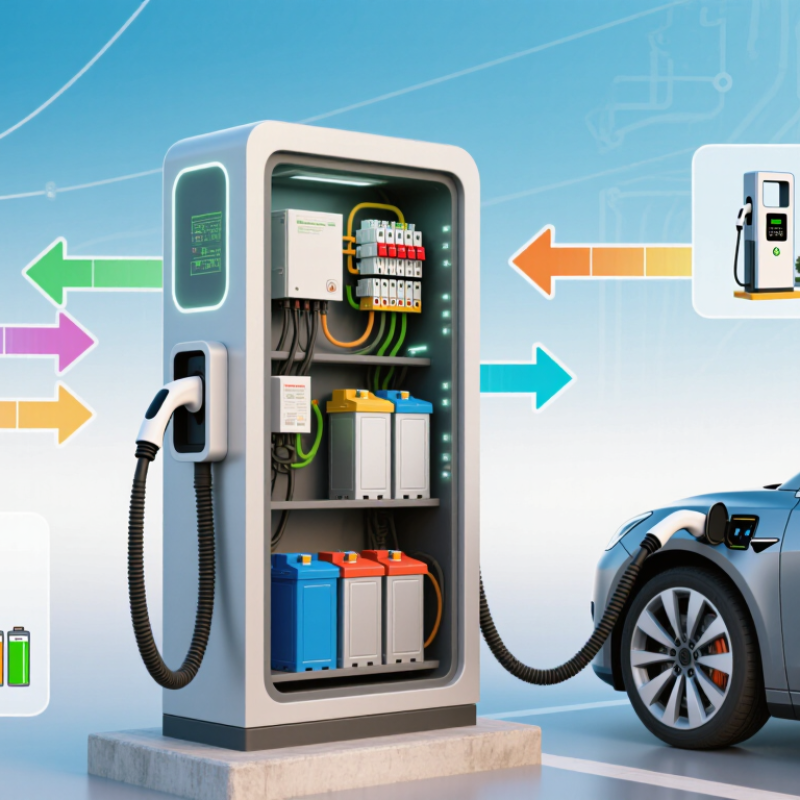
What an EV Power Station Is and What It Does
An EV power station is equipment that supplies electricity to an electric vehicle’s battery. It may be a compact home wall unit or a larger public charging cabinet. The station does not create energy; it safely controls how power moves from a building or grid into the car. Inside, switching components, sensors, and communication software coordinate the process. Simple idea.
With AC charging, the station provides alternating current, and the vehicle’s onboard charger converts it into battery-ready direct current. A DC fast-charging station performs that conversion itself, then sends controlled DC power to the vehicle. The car and station exchange information about voltage, temperature, and charging limits. If conditions change, charging can slow or stop. That exchange is easy to overlook.
A station also manages practical tasks: confirming a connection, measuring energy use, and responding to faults such as excess current or overheating. Some units balance available power across several vehicles, reducing strain on a site’s electrical supply. Actual charging speed depends on the vehicle, battery temperature, station rating, and local power capacity—not just the number printed on the charger. A display may suggest precision, but real-world sessions vary.
The Main Components of an EV Power Station
An EV power station combines grid equipment, power converters, charging dispensers, and control systems. The grid connection feeds a transformer and switchgear, which regulate incoming voltage and isolate faults. Power electronics convert electricity into a form the vehicle can use. With AC charging, conversion happens mainly inside the vehicle. With DC fast charging, the station converts power before it reaches the vehicle. That split matters. It affects equipment size, heat, and charging speed.
Dispensers deliver power through cables and connectors; cooling systems help manage heat during high-power charging. Controllers coordinate charging, while meters track energy use and safety systems can cut power when they detect faults. Battery storage is optional, but it can help a site manage demand peaks. The International Energy Agency’s Global EV Outlook 2024 reports that public charging points worldwide exceeded four million in 2023, up about 40% from 2022. Its 2023 outlook recorded roughly 2.7 million public points at the end of 2022. These totals show rapid expansion, but they do not reveal how reliably stations operate. A tidy equipment diagram misses the practical complications: heat, cable wear, and uneven site power. Small details matter.
What Is an EV Power Station and How Does It Work?
The Main Components: Example 150 kW DC Fast-Charging Station
Grid power enters through the station’s electrical protection and control equipment. AC-to-DC power modules convert it into DC, which flows through the DC bus and charging cable to the vehicle’s battery. This illustrative configuration uses three 50 kW modules for a combined rated output of 150 kW; actual station designs and delivered charging power vary.
How Electricity Reaches the Vehicle
What Is an EV Power Station and How Does It Work?
How Electricity Reaches the Vehicle
An EV power station connects the electrical grid to a vehicle through charging equipment, a cable, and a control system. The station checks the vehicle’s connection and charging limits before electricity flows. With AC charging, power enters the vehicle as alternating current; the car’s onboard charger converts it into direct current for the battery. With DC fast charging, conversion happens inside the station, so DC reaches the battery directly. That’s the key difference. The charging system adjusts power as conditions change, and fast charging often slows as the battery fills. Real charging is less tidy than a simple plug-in: temperature, battery level, and equipment capacity all affect speed.
The International Energy Agency’s Global EV Outlook 2024 reports that public charging points worldwide grew by about 40% in 2023, to more than four million. More stations make access easier, but their power ratings and connector compatibility still matter. One detail is often overlooked: the vehicle, station, and cable must all support the power level being used.
Tips: Check the vehicle’s stated charging limits before choosing a station. Seat the connector fully, then confirm charging has started on the vehicle display. If power seems low, check the battery level and station rating; a fault is possible, but not the only explanation.
How Charging Is Managed and Monitored
An EV power station manages charging by coordinating its chargers, vehicles, and available electrical capacity. Its control system can assign power across connected vehicles instead of letting every charger draw its maximum at once. Each charging unit reports details such as energy delivered, connection status, and faults. When demand rises, the system may reduce charging speed or shift power to another vehicle. For example, several cars plugged in after work may share a limited supply. When one car finishes, its available capacity can be redirected. Small changes matter.
Monitoring continues while vehicles charge. A dashboard can show live power use, session duration, and alerts, helping staff spot an unplugged cable or an interrupted session. In practice, a green status light is useful, but it is not proof that every reading is exact. Vehicle battery data may be unavailable or delayed, depending on the connection. If communication drops, a charger may pause or follow a preset limit. That is not magic. Operators should check alerts and compare session records with energy-meter readings. A display can simplify a complex system, but it cannot replace careful review.
Power Levels, Safety Features, and Grid Connections
An EV power station supplies electricity to a vehicle through a charging cable. Its power level, measured in kilowatts, affects charging speed. AC stations send alternating current to the car, where its onboard charger converts it for the battery. DC fast chargers perform that conversion inside the station. A higher power rating does not guarantee faster charging: the vehicle’s limits, battery temperature, and current charge level also matter. Grid capacity matters too. A site may need upgraded electrical service before it can support several high-powered chargers.
Safety features help manage everyday risks. Look for grounding, overcurrent and leakage protection, temperature monitoring, and secure connectors. Well-designed equipment stops or reduces power when it detects a fault. Installation and maintenance should be handled by qualified professionals, with cables checked for cuts or damaged plugs. Small details matter. A charger’s rating alone cannot tell you whether a site is suitable or reliably maintained.
Tips: Check your vehicle’s maximum AC and DC charging rates before choosing a station. In cold weather, allow extra time; battery conditioning can affect charging speed. If a connector feels unusually hot or looks damaged, stop using it and report the issue. Don’t assume the most powerful unit is always the best fit.
What Is an EV Power Station and How Does It Work? - Power Levels, Safety Features, and Grid Connections
| Dimension | Type or component | Typical details | How it works |
|---|---|---|---|
| Purpose | EV charging station | Supplies electrical energy to charge an electric vehicle. | The station connects the vehicle to an electrical supply and coordinates charging. With AC charging, the vehicle converts incoming AC power to battery-ready DC; with DC fast charging, conversion takes place in the charger. |
| Power level | Level 1 AC (North America) | Typically uses a 120 V outlet and provides about 1–1.9 kW, depending on current and circuit limits. | Uses a standard household AC supply and is generally suited to low-mileage driving or longer parking periods. |
| Power level | Level 2 AC (North America) | Usually supplied at 208–240 V. Charging equipment commonly ranges from roughly 3.3 to 19.2 kW; the vehicle and circuit may limit the actual rate. | A dedicated circuit supplies AC power to the vehicle’s onboard charger. The onboard charger determines how much power the battery can accept. |
| Power level | DC fast charging | Common equipment ratings range from about 50 to 350 kW. Actual charging power varies with the vehicle, battery temperature, state of charge, and charger capacity. | The station converts grid AC to DC and delivers it to the vehicle battery through a compatible charging connection. Charging power often reduces as the battery approaches a high state of charge. |
| Power conversion | AC-to-DC conversion | EV batteries store energy as DC electricity. | For AC charging, conversion is performed by the vehicle’s onboard charger. For DC fast charging, power-conversion equipment in the station supplies DC directly under vehicle control. |
| Safety features | Electrical protection | Depending on equipment and local code, protections may include overcurrent protection, ground-fault or residual-current protection, grounding checks, and temperature monitoring. | Protective devices monitor for unsafe electrical conditions and can interrupt power if a fault, excessive current, or overheating is detected. |
| Safety features | Charging control and communication | Charging equipment and the vehicle exchange signals before and during charging. | The system checks connection status and permitted current, then enables power only when the required conditions are met. DC charging also uses control and protection systems to monitor the charging process. |
| Grid connection | Residential installation | Typically connects to a building’s electrical panel through a suitably rated circuit. A Level 2 installation commonly requires a dedicated 208–240 V circuit in North America. | An electrician checks the service capacity, wiring, circuit protection, and applicable electrical codes. A load-management system may limit charging when other building loads are high. |
| Grid connection | Public or commercial site | May connect through a building distribution system or a dedicated transformer. Larger charging sites may require utility coordination and upgrades. | Transformers and switchgear adapt and distribute utility power to charging equipment. Site controls can share available power among chargers to manage peak demand. |
| Charging speed | Factors affecting actual power | Charging speed depends on the station rating, vehicle limits, battery condition, temperature, supply capacity, and charging-connection compatibility. | The vehicle and station regulate power together; the effective rate is limited by whichever part of the system can accept or provide less power at that moment. |
Note: Power ranges are indicative, not guaranteed charging rates. Electrical standards and terminology vary by country; installation must comply with local codes and be assessed for the specific site.