
Top Lithium RV Batteries for Your RV
A lithium rv battery can make quiet mornings, longer boondocking stays, and lighter payloads more achievable. But “lithium” alone does not guarantee a good fit. The right choice depends on usable capacity, charging compatibility, battery-management protections, cold-weather behavior, dimensions, and warranty support. Small details matter. A battery that cannot fit its compartment or work with the RV’s charger may create more hassle than freedom.
Market figures offer context, not a shortcut. The RV Industry Association reported 333,733 U.S. wholesale RV shipments in 2024. That shows the scale of the RV market, but it does not measure lithium-battery adoption. NREL’s Annual Technology Baseline tracks lithium-ion storage costs at utility scale; those figures should not be treated as direct RV battery prices. This distinction matters when comparing product claims with independent data. In the guide ahead, we assess leading options by practical specifications and explain what to verify before buying, including charge limits, low-temperature cutoffs, and real-world usable capacity. A larger amp-hour rating may look impressive, yet installation limits or incompatible charging can reduce its value. Even careful comparisons have limits: published tests may not match your exact rig, climate, or travel habits. Use the rankings as a starting point, then confirm details with the manufacturer and your RV documentation.
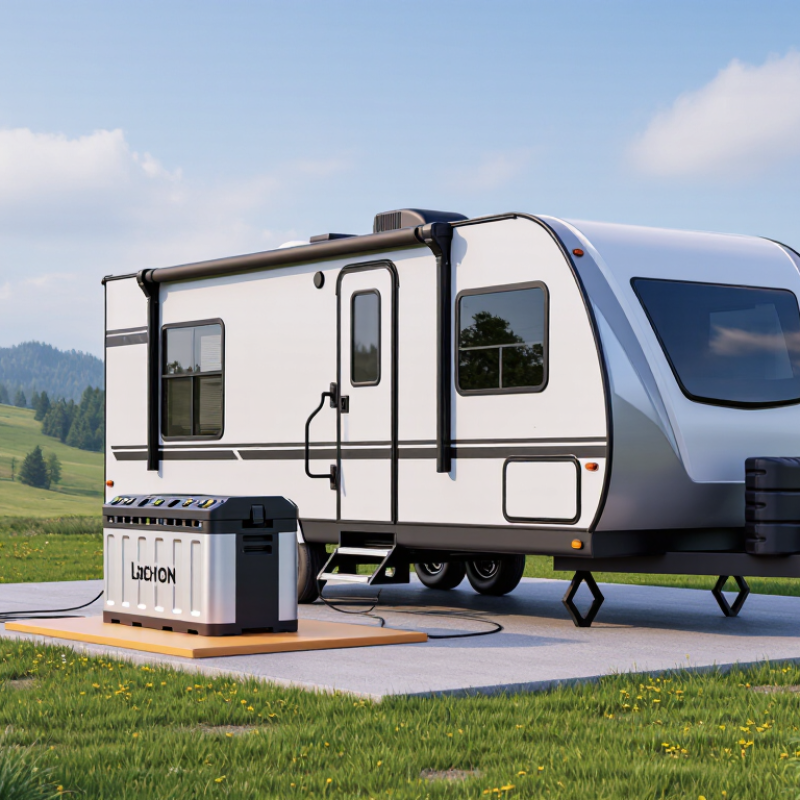
Understanding Lithium Batteries in RV Power Systems
Lithium batteries can make an RV power system lighter and more usable, but “lithium” alone does not tell you how the system will perform. Check the battery’s chemistry, rated capacity, continuous discharge limit, and built-in battery management system (BMS). The BMS helps protect cells from unsafe voltage and temperature conditions. A capacity label can still mislead.
For a useful benchmark, the National Renewable Energy Laboratory’s 2024 Annual Technology Baseline models utility-scale lithium-ion storage at about 85% round-trip efficiency. That figure describes large stationary systems, not an RV battery’s guaranteed efficiency. Still, it illustrates an important point: energy is lost as power moves through storage and conversion equipment. An inverter, wiring, and appliances add their own demands. Size the battery around actual loads, such as a refrigerator overnight or a coffee maker’s brief surge.
Charging compatibility deserves close attention. Confirm that the converter, solar controller, and alternator charging setup use settings suitable for the battery’s chemistry. Check the manufacturer’s temperature limits, especially before charging in freezing conditions. Also compare continuous and peak output with your inverter’s needs. Small details matter. A system may have plenty of stored energy but still struggle to run a high-demand appliance. Rechecking your load estimates after a few trips is sensible; real use can surprise you.
Key Specifications for Comparing RV Lithium Batteries
When comparing RV lithium batteries, start with usable energy, not the amp-hour figure alone. A 12.8-volt, 100-Ah battery stores about 1.28 kWh before conversion losses. Check the manufacturer’s discharge limit and continuous current rating against your inverter, fridge, and other loads. A kettle can expose a weak match quickly.
Cycle-life claims need context. Compare the stated cycles at the same depth of discharge, temperature, and end-of-life capacity; otherwise, the figures are not directly comparable. Check the battery management system’s low-temperature charging cutoff, too. Cold matters. Also compare weight, dimensions, terminal type, and charging limits with your RV’s compartment and charger. I still find it easy to overlook charging compatibility when a capacity figure looks attractive.
For cost comparisons, calculate price per usable kilowatt-hour, then consider warranty terms and usable capacity over time. The International Energy Agency reported that lithium-ion battery pack prices fell 14% in 2023 in its Global EV Outlook 2024. That market trend is useful context, not proof that any RV battery offers better value. Ask for test conditions behind performance claims, and treat unusually high cycle counts cautiously. Raw numbers can mislead.
Top Lithium RV Batteries for Your RV — Key Specifications for Comparing RV Lithium Batteries
Compare these common LiFePO₄ battery configurations by nominal capacity, stored energy, charging requirements, and typical RV use. Values are representative configuration figures, not specifications for particular products.
| Battery Configuration | Nominal Voltage | Capacity | Nominal Energy | Estimated Usable Energy at 80% Depth of Discharge | Typical Charging Voltage Range | Common RV Application |
|---|---|---|---|---|---|---|
| Compact 12V-class LiFePO₄ | 12.8 V | 100 Ah | 1.28 kWh | About 1.02 kWh | 14.2–14.6 V | Small travel trailers, weekend trips, and modest 12V loads |
| High-capacity 12V-class LiFePO₄ | 12.8 V | 200 Ah | 2.56 kWh | About 2.05 kWh | 14.2–14.6 V | Longer off-grid stays and RVs with greater daily energy use |
| 24V-class LiFePO₄ | 25.6 V | 100 Ah | 2.56 kWh | About 2.05 kWh | 28.4–29.2 V | 24V electrical systems or installations designed for higher-voltage components |
| 48V-class LiFePO₄ | 51.2 V | 100 Ah | 5.12 kWh | About 4.10 kWh | 56.8–58.4 V | Large off-grid systems with compatible 48V inverters and charging equipment |
Comparison notes: Nominal energy is calculated as nominal voltage × amp-hours. The 80% usable-energy figures are planning estimates, not guaranteed limits; actual usable capacity depends on the battery’s specifications and operating conditions. Confirm the battery-management-system (BMS) continuous and surge current ratings against inverter and appliance demands. Charging-voltage ranges are typical for LiFePO₄ systems; follow the battery and charger manufacturers’ instructions. Charging below 0°C (32°F) is generally restricted unless the battery has suitable low-temperature protection or heating. Cycle life varies with cell design, depth of discharge, temperature, and charging practices.
Top Lithium RV Battery Options and Their Best Uses
A 100Ah lithium battery often suits weekend trips with lights, a refrigerator, and device charging. It can save weight compared with many lead-acid setups. But check your actual daily energy use before choosing capacity. A few cloudy days can change the plan. For longer stays without hookups, a 200Ah setup offers more reserve for cooking appliances, fans, and a modest inverter. High-power appliances still need careful planning; battery capacity alone does not determine whether an inverter can handle startup surges.
Cold-weather campers should look for batteries with low-temperature charging protection or built-in heating. Charging lithium batteries below their specified temperature can damage them. For a small RV, a compact drop-in battery may simplify installation, provided its voltage and charging profile match the existing system. Larger rigs may benefit from modular batteries, which can be easier to expand or service. Still, more capacity adds weight and cost. I would not assume that the biggest battery is the best choice.
Before buying, compare usable capacity, continuous discharge limits, battery-management protections, and charger compatibility. Leave room for real-world variation: cloudy weather, an aging solar panel, or an unexpectedly long evening can reduce your reserve. Capacity labels are tempting to trust at a glance. I would check the specifications twice, and admit that load estimates are rarely perfect.
How to Match Battery Capacity to Your RV’s Power Needs
A useful battery estimate starts with your daily energy use, not the battery’s advertised amp-hour number. List each appliance, its watts, and hours of use; multiply watts by hours to get watt-hours. A 12-volt, 100Ah battery stores about 1,200Wh nominally. For example, a 60W refrigerator running for 10 hours uses 600Wh, while lights drawing 30W for four hours use 120Wh. Small loads add up. Include water pumps, device charging, and inverter losses.
Add the daily totals, then allow room for conversion losses and reserve capacity. If your example loads total 745Wh, a 15% allowance raises the estimate to about 857Wh. At 80% usable capacity, you would need roughly 1,070Wh nominally, so one 100Ah battery may be tight. Actual usable capacity depends on the battery’s specifications, temperature, and discharge limits. The U.S. Department of Energy’s 2019 Energy Storage Technology and Cost Characterization Report uses 85% round-trip efficiency for modeled lithium-ion storage systems. That figure is a planning reference, not a guarantee for an RV installation.
Compare your estimate with real trips. A cold night, longer refrigerator cycles, or extra laptop use can change the daily total. Check the battery maker’s usable-capacity guidance, and measure consumption with a meter when possible. I have found estimates are easy to underestimate—especially when small devices stay plugged in.
Installation, Charging, and Care for Long-Term Performance
A lithium RV battery performs best when its installation matches the battery’s specifications. Secure it upright in a dry, ventilated compartment, away from loose tools and sharp edges. Use cable sizes and fuse ratings recommended by the manufacturer, and place the required fuse close to the positive terminal. Tighten connections firmly, but do not force the hardware. Small details matter. Before powering the system, check polarity and confirm that the battery management system is connected as directed. A wiring diagram can prevent an expensive mistake.
Charging needs equal care. Use a charger with a profile made for the battery’s chemistry; a lead-acid setting may not be suitable. Check the charger manual, alternator setup, and solar controller settings rather than assuming they are compatible. If the battery lacks verified low-temperature charging protection, avoid charging it below freezing. That detail is easy to overlook on a cold morning. During storage, follow the battery maker’s guidance for charge level, and disconnect loads that quietly drain power. Every few months, inspect cables for corrosion, looseness, or heat damage. I would not rely on a dashboard reading alone; compare it with the battery monitor and investigate unusual drops. A little routine checking helps catch problems before a trip.
Top Lithium RV Batteries: Typical 12V LiFePO₄ Charging Voltages
Use these common voltage ranges as a starting point when setting up your RV charging system.
Bulk/absorption voltage is commonly around 14.2–14.6 V. Float charging is often unnecessary for LiFePO₄ batteries; if used, a lower setting is typical. Follow your battery and charger manuals, and do not charge below the battery’s specified minimum temperature.