How to Choose the Right RV Water Pump

Choosing the right rv water pump begins with understanding how your coach actually uses water. Do you run one faucet at a time, or shower while someone washes dishes? Is the pump close to the tank, or does it push water through long, narrow lines? These details affect pressure, flow, noise, and cycling. The largest rating is not automatically the best fit.

The RV Industry Association reported 333,733 wholesale RV shipments in 2024, up from 313,174 in 2023 (RVIA, 2024 shipment report). That market data shows how many owners depend on reliable onboard systems, though it does not measure pump performance. For a useful technical comparison, SHURFLO’s 4008 product specifications list a maximum flow of 3.0 gallons per minute and a 55-psi shutoff pressure. Treat those figures as product ratings, not a promise of identical flow at every faucet.

Numbers aren’t everything. RV technician and writer Dave Solberg’s maintenance guidance can be paraphrased as a practical rule: match the pump to the coach’s plumbing and real water-use habits, rather than choosing by headline rating alone. This is a paraphrase, not a verbatim quotation. Before buying, check the existing pump’s voltage, fittings, pressure setting, and available mounting space. Listen for the sharp knocking that can signal vibration against a cabinet wall. A quieter model may still disappoint if its flow is too low. There is no perfect pick. Even careful advice has limits: worn plumbing, clogged filters, and low battery voltage can change what a pump delivers.
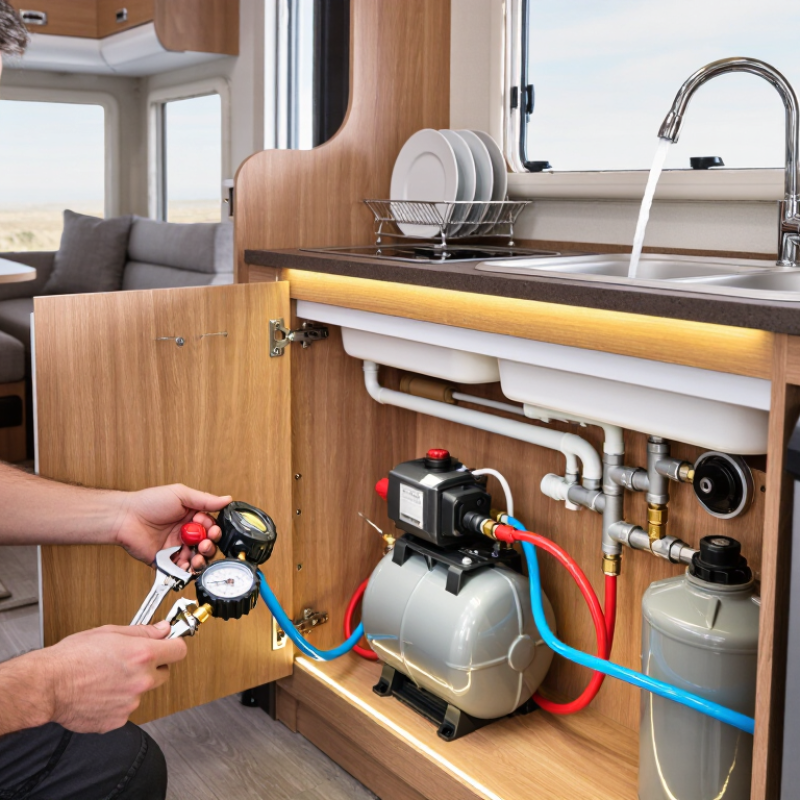
How to Choose the Right RV Water Pump

Identify Your RV’s Water System and Water-Use Needs

Identify whether your RV draws from an onboard freshwater tank or a pressurized campground connection. A 12-volt pump typically serves the tank system; campground water usually bypasses it. That changes everything. Check the owner’s manual for pump flow, pressure limits, and plumbing restrictions. Then count likely simultaneous uses: a shower running while someone rinses dishes creates a different demand than a single sink tap. Note tank size, pipe length, and elevation too. A pump’s advertised flow may not match delivery at your faucet.

The U.S. EPA’s WaterSense program reports that an average family uses more than 300 gallons of water daily at home, with roughly 70 percent used indoors. The USGS’s 2015 national water-use report estimates domestic public-supply use at about 82 gallons per person per day. These are household benchmarks, not RV-use targets. RV tanks hold far less, so track your own showers, dishwashing, and toilet use over a typical trip. It is easy to overestimate your needs. A quiet weekend with one occupant may call for less capacity than a full campsite with several people using fixtures together. Record what actually happens before choosing. A little guesswork remains, but tank level and faucet behavior offer better clues than household averages.

How to Choose the Right RV Water Pump

Estimate the flow your water system needs when fixtures run individually or at the same time.

Typical planning estimates: an RV shower uses about 1.5 GPM, while faucets and other fixtures vary by model. The combined shower-and-faucet bar illustrates simultaneous demand. Check your fixtures and compare pump flow at the required operating pressure; a pump’s maximum flow rating may not reflect its flow under pressure.

Understand Pump Types, Flow Rates, and Pressure Ratings

Choosing an RV water pump starts with its design. Most RVs use a 12-volt diaphragm pump that switches on when pressure drops. Fixed-speed models are straightforward, while variable-speed versions adjust output as taps open and close. Hand pumps can provide water without power, but they are usually better suited to a backup sink. Simple, but not always quiet.

Flow rate matters most when several fixtures may run together. A pump’s advertised gallons per minute often describes output under ideal conditions, not at your showerhead. Check its flow at a stated pressure, then compare that figure with your likely use. A quick bucket test at a faucet can reveal whether your existing system feels weak. The result is only a guide; pipe length, filters, and fittings also affect delivery.

Pressure ratings need the same careful reading. Compare the pump’s operating and shutoff pressure with the limits listed for your RV’s plumbing, water heater, and fixtures. A higher rating is not automatically better. It may cause cycling, noisy pipes, or unnecessary strain. An accumulator tank can soften pulsing, but it will not fix an undersized pump or clogged filter. Check the RV manual and component specifications before replacing anything; the right choice is a balance, not a single impressive number.

Match Pump Capacity to Your RV’s Fixtures

Match pump capacity to the fixtures you actually use together, not every fixture in the RV at once. A shower running while someone rinses dishes creates a different demand from a single faucet. Check each fixture’s stated flow rate, then add the rates for likely simultaneous use. Leave a modest margin for normal variation. Not every tap runs wide open.

Read the pump’s flow rating alongside its pressure rating or performance chart. Maximum flow is often measured under conditions that do not match real plumbing. A long hose, narrow pipe, filter, or several fittings can reduce delivery. In practice, a pump that supplies enough water at your system’s working pressure matters more than an impressive maximum-flow figure. I used to focus too much on that headline number.

Also check the RV’s plumbing and electrical specifications before choosing a higher-capacity unit. An oversized pump may cycle frequently, feel noisy, or push a small system harder than needed. A compatible accumulator tank can reduce rapid cycling, but it does not increase the pump’s actual capacity. If water pressure fades when the shower and kitchen tap run together, compare their combined demand with the pump’s performance at operating pressure. Then inspect restrictions and leaks; the pump may not be the problem.

How to Choose the Right RV Water Pump - Match Pump Capacity to Your RV’s Fixtures
Fixture or Setup Typical Flow or Demand How to Estimate Your Peak Demand Practical Pump Capacity Guide
Kitchen faucet About 0.5–1.5 GPM, depending on the faucet and any flow restrictor Count the faucet if it may run while another fixture is in use. Include its expected flow in the total for fixtures used at the same time.
Bathroom faucet About 0.5–1.0 GPM Add its flow when simultaneous use is likely, such as during shower use. Include its expected flow in the total for fixtures used at the same time.
RV shower Often about 1.5–2.5 GPM; actual flow varies by showerhead and restriction. Use the shower’s measured or specified flow, then add any faucet likely to run at the same time. For a shower plus one faucet, a pump rated around 3–4 GPM is a common starting point.
Toilet Intermittent refill demand; flow varies by toilet and valve. Toilet refill is brief and is not usually treated like a continuously running faucet. Consider it if refill occurs during other water use. Check that the pump and plumbing maintain usable pressure during refill; do not size from flush volume alone.
One faucet at a time Typically about 0.5–1.5 GPM Base the estimate on the faucet with the highest expected flow. A pump rated around 2–3 GPM may suit a modest setup, subject to its performance at working pressure.
Shower plus one faucet Often about 2.0–4.0 GPM combined, depending on the fixtures. Add the two fixture flows. For example, a 2.0 GPM shower plus a 0.8 GPM faucet is about 2.8 GPM. A pump rated around 3–4 GPM is a practical starting point; allow margin for pressure losses and pump-curve performance.
Shower plus two faucets Often about 2.5–5.0 GPM combined, depending on the fixtures. Add only the flows you realistically expect to use simultaneously. A pump rated around 4–5.5 GPM may be appropriate when the plumbing and fixtures can support the demand.
Selection Checks
Rated flow versus delivered flow A pump’s advertised GPM may be measured under specific test conditions; delivered flow changes with pressure and system resistance. Compare the pump’s performance curve at the intended operating pressure, rather than selecting by maximum GPM alone. Choose a pump that can meet the estimated simultaneous demand at the pressure your system requires.
Operating pressure Many RV water systems operate in roughly the 40–55 PSI range, but requirements vary. Check the pump specifications, fixture limits, and RV plumbing guidance. Do not exceed the pressure rating of any part of the water system.
Measured fixture flow Flow can be estimated by collecting water in a container for a timed interval. GPM = gallons collected ÷ minutes. For example, 0.5 gallon collected in 30 seconds equals 1.0 GPM. Use measured flows to make the sizing estimate more specific to your RV.
Important sizing note These flow ranges are general planning estimates, not guaranteed values. Fixture restrictions, pipe size, elevation, filters, fittings, and pump performance all affect actual flow. Add the demand of fixtures likely to run together, then verify the pump’s performance curve and your RV’s pressure limits.

Check Power Requirements, Noise, and Installation Fit

Before buying an RV water pump, check the electrical system rather than relying on a similar model already installed. Compare rated voltage, running current, and startup demand with the available circuit. A pump may draw more briefly when it starts, especially under pressure. Check the fuse and wire guidance in the manual; undersized wiring can cause weak flow or overheating. Keep some capacity in reserve.

Noise can travel through cabinets and thin walls, so a pump that sounds quiet on a workbench may seem loud beside a bed. Look for vibration-isolating feet and mount the unit on a firm, flat surface. Listen from the sleeping area while taps run at normal flow. Listen from the bed. Flexible hose sections can reduce vibration transferred through rigid plumbing, though they will not silence every pump. Real-world noise varies with the installation.

Measure the mounting space, including room to reach the strainer, fittings, and electrical connections later. Check inlet and outlet sizes, port direction, and whether the pump can sit in the orientation its manual allows. Small gaps matter. Leave enough clearance to inspect for drips and remove the strainer for cleaning. Avoid bending hoses sharply or letting them press against cabinet panels. A neat fit may still need adjustment once the lines are connected, so test for leaks and steady flow before closing the access panel.

Compare Durability, Maintenance Needs, and Cost

Choosing an RV water pump means balancing durability, upkeep, and the cost of ownership. A pump that runs quietly at a campsite may still struggle when several fixtures are used together. Check its rated flow and pressure against your RV’s plumbing and typical water use. More capacity is not always better; an oversized pump can cycle frequently and create unnecessary noise.

Durability depends on more than the pump’s housing. Vibration, loose fittings, and running the pump dry can shorten its service life. A secure mounting surface and accessible inlet strainer make routine checks easier. Inspect hoses and connections for damp spots, and clean the strainer when debris collects. Before freezing weather, follow the manufacturer’s draining or winterizing instructions. Small checks matter.

Compare the purchase price with likely maintenance and replacement costs. A low-cost model may be reasonable for occasional trips, but frequent travelers may value sturdy construction and serviceable parts. Check whether replacement components are available before buying. A higher price does not guarantee longer life, though. That calculation is imperfect: water quality, installation, and use all affect wear. Choose a pump you can maintain comfortably, not just one with the lowest number on the shelf.